Partner Delia West Marble
Queer Places:
Bryn Mawr College (Seven Sisters), 101 N Merion Ave, Bryn Mawr, PA 19010
University of Chicago, 5801 S Ellis Ave, Chicago, IL 60637, United States
Columbia University (Ivy League), 116th St and Broadway, New York, NY 10027
Barnard College (Seven Sisters), 3009 Broadway, New York, NY 10027
Evergreen Cemetery, 65 Martin Luther King Ave, Morristown, NJ 07960, United States
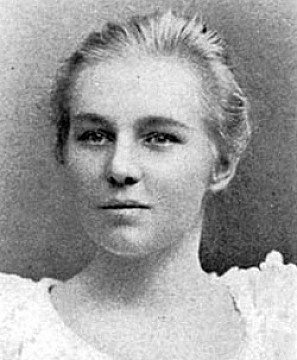 Dr. Ida Helen Ogilvie (February 12, 1874 - October 13, 1963) was a pioneering American geologist, dedicated educator, and agricultural innovator who
broke gender barriers in higher education and sustainable farming during the early to mid-twentieth century.
Dr. Ida Helen Ogilvie (February 12, 1874 - October 13, 1963) was a pioneering American geologist, dedicated educator, and agricultural innovator who
broke gender barriers in higher education and sustainable farming during the early to mid-twentieth century.
Born in New York City on February 12, 1874, to Clinton Ogilvie, a celebrated landscape painter, and Helen Slade Ogilvie, also an accomplished artist,
she grew up in a wealthy family with colonial roots tracing back to the Mayflower. Educated in Europe and at The Brearley School in Manhattan, she
developed an early passion for natural sciences. She attended Bryn Mawr College, graduating in 1900 with a degree in zoology and geology after spending
summers conducting research at the Woods Hole Oceanographic Institution. Mentored by Florence Bascom, a trailblazer for women in earth sciences, Ogilvie
pursued graduate work at the University of Chicago under geomorphologist Rollin D. Salisbury before earning her Ph.D. at Columbia University in 1903
under petrologist James Furman Kemp.
Following her doctorate, Ogilvie joined the faculty at Barnard College, where she founded the institution's Geology Department. Over her
thirty-eight-year career at Barnard, she built the department from scratch into a nationally recognized program, advancing from lecturer to full
professor by 1938. Known for her innovative pedagogy and field research, she conducted groundbreaking studies on glacial geology in the Adirondacks,
British Columbia, and Maine, as well as volcanic petrology and arid erosion in the Ortiz Mountains of New Mexico, coining the geological term
"conoplain." She became a fellow of the Geological Society of America, the American Association for the Advancement of Science, and the New York Academy
of Sciences. Crucially, Ogilvie was the first woman to teach graduate-level geology courses at Columbia University, opening doctoral-level instruction to
female students.
Ogilvie’s life and legacy were deeply intertwined with her lifelong romantic and professional partner,
Delia West Marble. The two women met around 1917 through their involvement with the Woman's Land Army of
America during World War I, an initiative designed to mobilize female labor to offset wartime agricultural shortages. Together, they directed "Bedford
Camp" at Airlie Farm, Marble's sixty-acre estate in Bedford, Westchester County, New York. Ogilvie led over 150 women—popularly known as "farmerettes"—in
rigorous, scientific farm management, pitching hay, raising gold-medaled Jersey cattle, breeding pedigree collies, and tending laying hens. Following the
war, Ogilvie and Marble transformed Airlie Farm into a permanent cooperative agricultural model, advocating for formal agricultural training for young
women and proving that women could successfully run commercial agricultural enterprises without male labor or domestic trade-offs.
In 1930, Ogilvie expanded her agricultural and personal footprint by purchasing The Hermitage, a historic estate in Linlithgo, Columbia County, New
York (demolished in 1982). Working alongside architect Harold R. Sleeper, she extensively renovated the eighteenth-century manor house between 1937 and
1939, adding a portico and an upper story. During World War II, Ogilvie once again rallied to support the Woman's Land Army, utilizing The Hermitage as
an active, highly productive dairy farm stocked with registered Jersey cattle from Airlie Farm.
After retiring from Barnard College in 1941, Ogilvie spent her remaining years managing her agricultural properties and supporting educational and
civic causes. Delia West Marble served for years as the curator of the Barnard Geology collection, maintaining an active presence in Ogilvie's academic
and personal sphere until Marble's death. Ida Helen Ogilvie lived out the rest of her days at her beloved estate, where she died on October 13, 1963,
leaving behind an enduring dual legacy as a pioneer for women in academic science and a trailblazer for women in modern agriculture.
References:
- Barnard College Archives & Special Collections (New York, NY): Records of the Department of Geology, faculty files, administrative correspondence, and historical records related to the Barnard unit of the Woman’s Land Army of America (WLAA).
- Columbia University Libraries, Rare Book & Manuscript Library (New York, NY): Historical departmental records, graduate course rosters, and faculty files covering Ogilvie’s teaching in the Columbia University Graduate School of Arts and Sciences.
- Bryn Mawr College Special Collections & Archives (Bryn Mawr, PA): Alumnae records, undergraduate transcripts, and biographical files regarding Ogilvie (Class of 1900) and her work under geologist Florence Bascom.
- Livingston Historical Society & Local Records (Columbia County, NY): Historical documentation, deeds, and architectural preservation files regarding "The Hermitage" estate in Linlithgo, NY.
- Ogilvie, I. H. (1902). Glaciation of the Adirondack Mountains. Journal of Geology, 10(4), 392–412.
- Ogilvie, I. H. (1905). Geology of the Paradox Lake Quadrangle. New York State Museum Bulletin, 96, 461–508.
- Ogilvie, I. H. (1905). The High-Altitude Lakes of the Adirondacks. The American Geologist, 36.
- Ogilvie, I. H. (1905). An Analcite-Bearing Camptonite from New Mexico. The Journal of Geology, 13(4), 358–360.
- Ogilvie, I. H. (1908). Some Igneous Rocks from the Ortiz Mountains, New Mexico. Journal of Geology, 16(3), 230–238.
- Ogilvie, I. H. (1912). A Contribution to the Geology of the Ortiz Mountains, New Mexico. Annals of the New York Academy of Sciences, 22(1), 187–274.
- Arnold, Lois Barber (1984). Four Acre Field: Women in American Geology. Indiana University Press. (Includes detailed profiles of early female geologists, including Florence Bascom and Ida H. Ogilvie).
- Burek, Cynthia V., and Higgs, Bettie, eds. (2007). The Role of Women in the History of Geology. Geological Society, London, Special Publications, Vol. 281.
- Weiss, Malcolm M. (1997). Geological Society of America Memorials. Geological Society of America. (Contains official memorial tributes and biographical sketches of fellows).
- Weiss, Malcolm M. (1992). Ida H. Ogilvie (1874–1963): Geologist, Teacher, Farmer. Geological Society of America Abstracts with Programs, 24, A247.
- Weiss, Malcolm M. (2000). Ida Helen Ogilvie (1874–1963). In GSA Memoir 193: Forefront of Science. Geological Society of America.
- The Brooklyn Daily Eagle: "In Encouraging Young Women to Go Into Farming, She Says: 'Get Training...'" (August 4, 1929, p. 72). Feature article on Dr. Ida H. Ogilvie, Delia West Marble, and Airlie Farm.
- "Farmerettes Take Care of All the Stock at Airlie" (February 1, 1931, p. 70). Reportage on the ten-year success of the female-operated farm in Bedford, NY.
- "Dr. Ida H. Ogilvie, Geologist, Was 89; Headed Department at Barnard—Led Woman's Land Army" (October 15, 1963).
- The New York Biographical and Genealogical Record (1920s edition): Biographical profile under "OGILVIE, Ida Helen, educator and scientist."
- HouseHistree Entry: "The Hermitage, Linlithgo, New York" (Documents ownership, architectural alterations by Harold R. Sleeper, and connection to partner Delia West Marble).
- Geological Society of America (GSA) Archives: Record of Fellowship (1906–1963) and official membership details.
Support this project
This website is a passion project researched, developed, and funded entirely by me. If you find the content valuable and would like to help support the ongoing research and hosting costs, any contribution is deeply appreciated.
Thank you for keeping this independent resource alive!
My books on Amazon: Elisa Rolle's books
BACK TO HOME PAGE